Digestive Drag special report cover

The overlooked explanation for bloating that comes and goes.

Same man. Same order. Two weeks apart. Ever wonder what changed after the last bite? Me, too. So I went and looked. Here's the first thing I learned: your stomach never hands a meal over all at once. It meters it forward, a little at a time. Which is why the same dinner can land two ways. From the editor's desk, Liverated.

An ordinary Friday dinner

The meal was familiar. The ending wasn't.

Two weeks earlier, he had ordered the same dinner at the same restaurant and felt perfectly fine. Tonight, before the plates were cleared, his belt was already one notch too tight.

A man in a restaurant booth leaning back from a half finished plate

The evening had a plan. A good meal. One glass of wine. Then a walk through town while the night was still theirs.

But a dull pressure built under his ribs instead. His stomach pushed at his shirt.

The booth stopped feeling comfortable and started feeling like a seat he could not leave.

His wife noticed him leaning back. She asked if he was all right.

"Fine. Just full."

That was easier than the truth.

The night was over.

Not officially. His wife was still dressed for an evening that had barely started.

But he already knew the rest. Loosen the belt in the car. Drive straight home. Then wait for his body to give him permission to feel normal again.

The same man later that evening on the couch

And if you know that feeling, the cost is bigger than a tight waistband. After enough evenings like that one, you start managing the risk in advance.

You begin making your life smaller before the bloating can do it for you.

You decline the invitation. You order the safe meal. You work out the distance home before anyone else has finished eating.

Now here's the part that makes this so hard to pin down.

A meal that leaves you swollen and miserable on Friday can pass without trouble the following Tuesday. Same restaurant. Same order.

Nothing about the order changed. The result did!

So what exactly are you supposed to avoid?
Inside this report

Nothing below asks you to believe a story. Every line is paid off by a section of this report, a milligram on the label, or a number from the twelve-week study.

  1. 1
    Cut the bread, skip the dairy, eat slower, and the bloating ends. Right? Wrong. The same dinner that finished his Friday passed without a word the following Tuesday. A food list can name a suspect. It can't explain why that suspect walks free on a different night... and the thing that CAN explain it happens after the last bite.
  2. 2
    Why your enzyme capsule can do its job perfectly and your belt still gets tight an hour later. An enzyme works on one food component, early in the meal. Then it stops. Your dinner still has two more jobs ahead of it... and neither one has anything to do with what you ate.
  3. 3
    One meal, three handoffs, and the single handoff that decides how your whole evening goes. Your stomach meters the meal forward. Bile joins it farther down. The bowel moves what's left. When one of the three runs slow, everything behind it waits... which is how the same order can end two different ways.
  4. 4
    Never judge a bottle by its ingredient research. The study behind an ingredient can use ten times the amount that's in the bottle. There's a test that outranks any ingredient paper, and almost every bottle on the shelf fails it. Three tests, in fact... and you can run all three in the store in under a minute.
  5. 5
    The 20-second label test. If a label hides its amounts behind one "proprietary blend" total, you can't judge what you're taking, and neither can your pharmacist. Here's what a label has to show you, line by line, before a bottle earns a place in your morning.

Why the sensible fixes kept missing

The first crack in the food explanation.

If you're like most people, you blamed the food first. So did he.

Cut the bread. Skip the dairy. Eat slower. Food can be a trigger, and portion size and speed matter too.

But here's the problem. The same dinner that finished his Friday passed without a word the following Tuesday. Same restaurant. Same order.

A food list can name a suspect. It can't explain why that suspect walks free on a different night!

So you move on to the shelf. Three reasonable purchases usually follow, in roughly this order.

  1. 1
    Digestive enzymes. Built to act on a food component. One job, done early, and it says nothing about the rest of the trip.
  2. 2
    Probiotics. Aimed at the gut environment. A different job again, and a slower one.
  3. 3
    Bowel-movement products. These act near the end. They say nothing about what happened at the start.

Each fix answered a narrower question than your body kept asking.

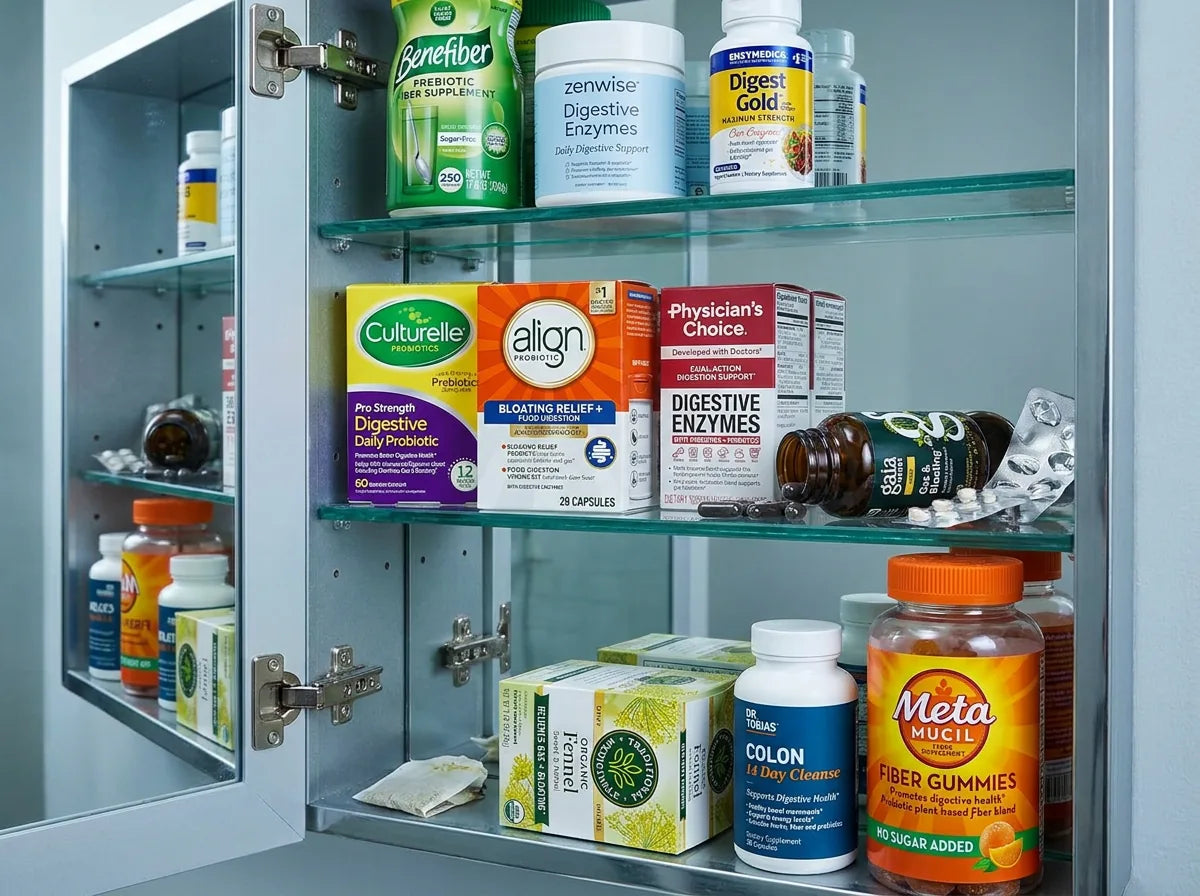
An open bathroom cabinet crowded with digestive enzymes, probiotics, gas relief capsules, fiber, a colon cleanse and digestive tea

Which is how the cabinet fills.

One bottle before the meal ... one after it ... a powder in the morning ... and a blister pack you can't remember starting.

Something seems to work for a week. Then the pressure comes back, and you shop again.

But no bottle in that cabinet ever asked the obvious question: what actually happens to a meal after the last bite?

A better question

Digestion isn't one event.

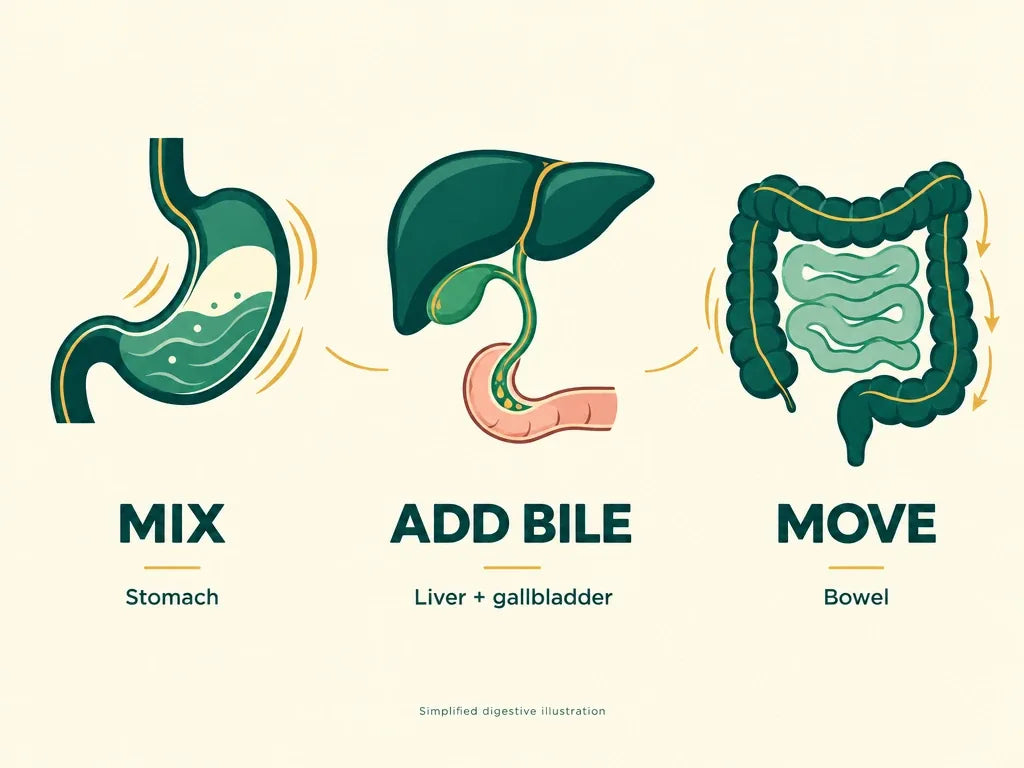
It's a handful of physical jobs that overlap. The stomach mixes the meal and meters it forward. Bile joins it farther down. And the bowel keeps the remainder moving.

Each job changes what the next one receives. You never feel the steps.

You feel the total!

The heavy, still-full feeling after an ordinary meal is what we call Digestive Drag.

It names an experience, not a diagnosis. Bloating has many causes, and no feeling can tell you which one is yours.

So what exactly are you supposed to avoid?
Here's what I found out. You can't answer that one from a food list. You answer it by asking what has to happen after the last bite.

DIGESTIVE HANDOFF #1

What does your stomach actually do with dinner?

Simplified digestive illustration showing the stomach, the liver and gallbladder, and the bowel

It churns what you ate into a soft mixture, then meters that mixture into the small intestine a little at a time, never in one load.

That release is the first handoff.

And when a meal gets handled slowly, it sits. Food that sits takes up room. Room turns into pressure.

Pressure is the thing you feel against your belt an hour after dinner.

So what about the enzyme capsule you tried? It goes to work on one food component. Lactose. Gluten. Beans.

It does that one job, and then it stops.

And about how the whole meal is being moved along? Not a word!

So once the stomach lets the meal go, what meets it on the other side?

DIGESTIVE HANDOFF #2

Where does the second handoff come from?

Simplified digestive illustration showing the stomach, the liver and gallbladder, and the bowel

Your liver makes bile, your gallbladder stores it between meals, and when food reaches the small intestine that bile joins it there and does the work of digesting fat.

That's the second handoff.

None of that means your liver is in trouble.

Bile is a normal part of digesting an ordinary meal. And a rich dinner asks more of it than a plain one does.

Same stomach. Same portion. A different amount of fat to hand off.

So what about the probiotic? It works on the gut environment, further down the line.

Your dinner met the bile handoff long before it ever met a probiotic!

The meal has been mixed. It has been joined. What moves it on?

DIGESTIVE HANDOFF #3

The last handoff decides how tomorrow morning feels.

Simplified digestive illustration showing the stomach, the liver and gallbladder, and the bowel

The intestinal tract keeps mixing and moving what is left of the meal, and that steady movement is the only thing carrying the remainder onward toward the finish.

It's the final handoff.

And when it runs slow, the backlog doesn't stay quiet. You feel it that evening. Then again at breakfast, before you have eaten a thing!

Bowel products act near the end of that line. They say nothing about how the meal started.

Three handoffs, one meal. We call that the Triple Relay.

A relay only moves as fast as its slowest leg. When one handoff runs slow, everything behind it waits. And the slow leg isn't the same leg every night.

Simplified digestive illustration showing the stomach, the liver and gallbladder, and the bowel
Simplified digestive illustration.

The Triple Relay is our way of organizing three known jobs. The study you will see measured symptoms, not the handoffs themselves.

So the question changed. What would a formula look like if it were built with all three handoffs in mind?

Three tests a bottle has to pass before it earns your morning.

So here's the standard. Write it down before you buy anything else.

Three tests. A bottle passes all three, or it doesn't go in your morning.

  1. Test #1: A rationale wider than one fashionable ingredient. One ingredient covers one job. The pattern you live with runs across three.
  2. Test #2: Every amount printed on the label. If a blend hides its amounts behind a total, you can't judge what you're taking. And your clinician can't either.
  3. Test #3: Evidence from the finished formula, at the serving on the label. Ingredient studies explain the thinking. A study of the actual bottle shows what happened when people took it.

Most bottles fail the first test. And almost all of them fail the third!

AFTER ALL THREE TESTS

AlphaCleanse is the one bottle that passed.

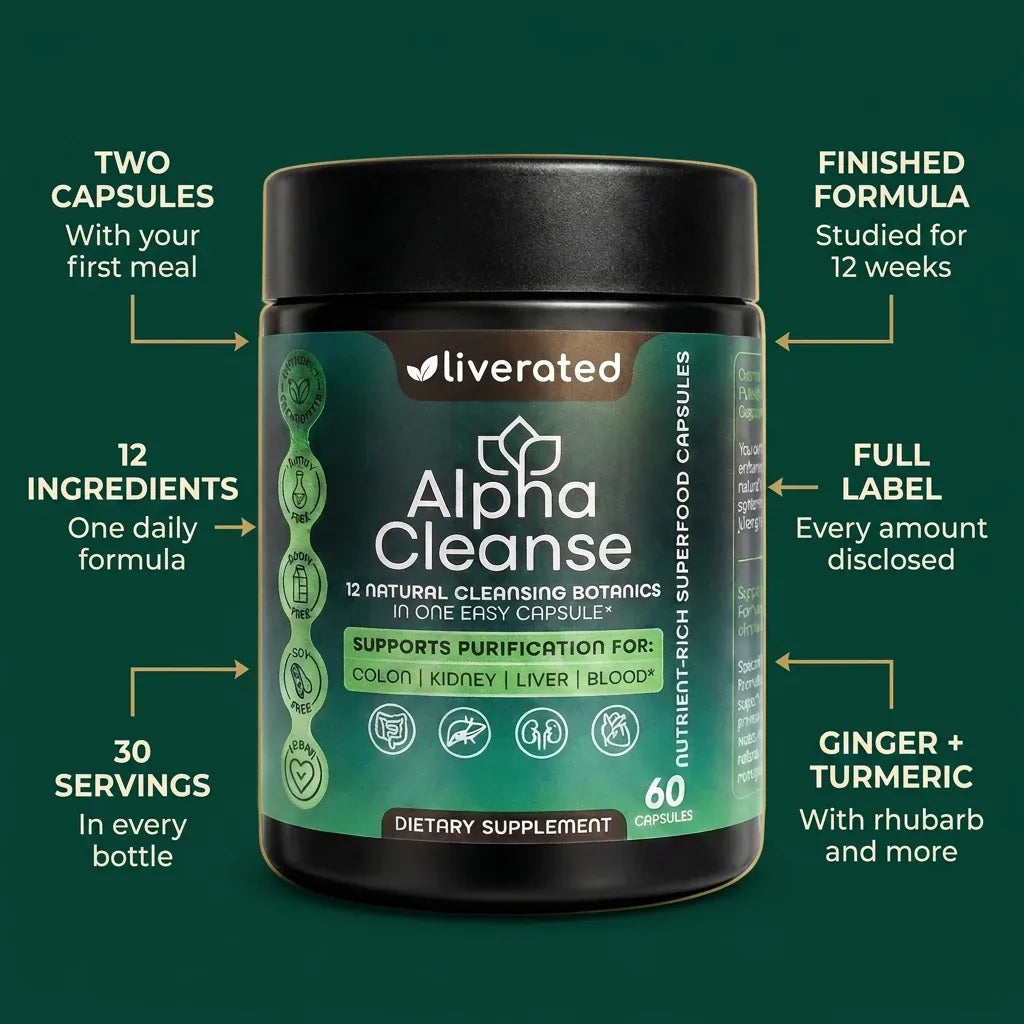
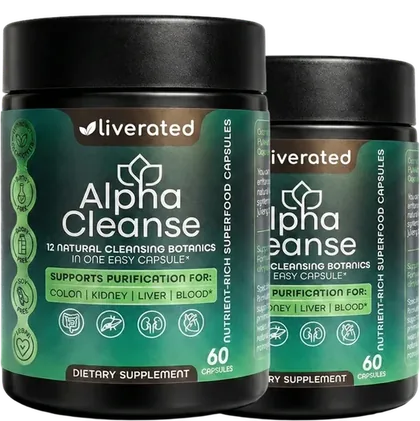
AlphaCleanse bottle with factual callouts

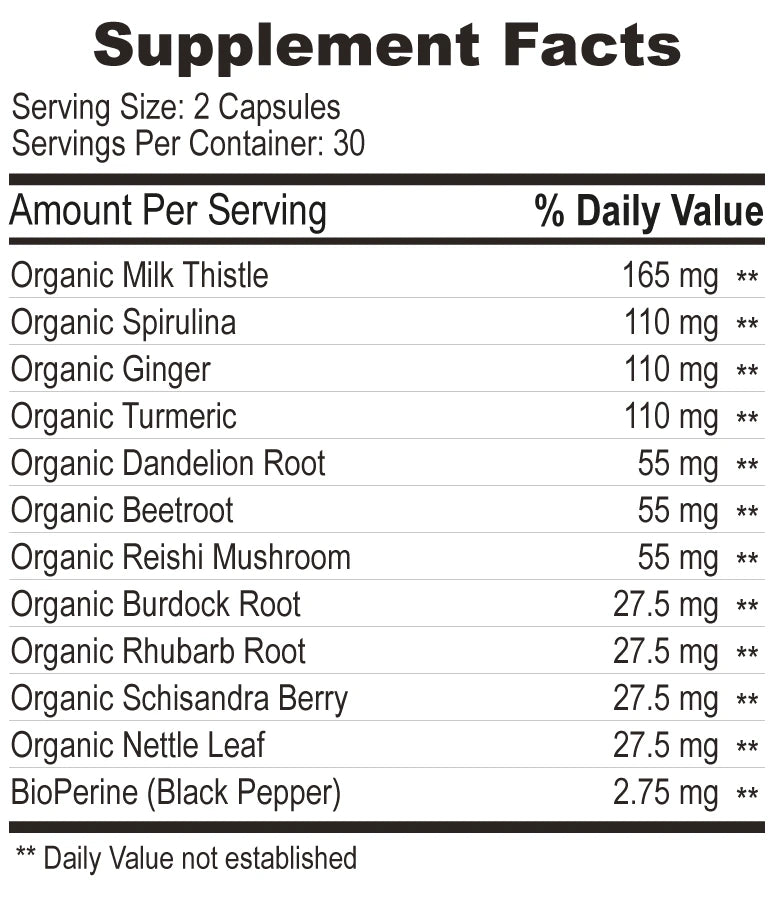
Twelve ingredients. Every amount printed on the label. 772.75 mg per serving.

Two capsules once daily, with your first meal. That's the whole routine!

Ginger, turmeric and rhubarb are the three anchors, one for each handoff. Nine more botanicals complete the formula.

That's why I want you to have the three-bottle supply, the same ninety servings the study ran.

With your permission, I'd like to send it at $40 a bottle instead of $49.

There's no obligation to keep it, now or in ninety days.

But first, let me show you why those three names are on the front.

Get the 3-bottle study supply · $120

Three bottles, $120 instead of the regular $147. Free USA shipping.

David I., a verified buyer, in his own words.

David I., verified buyer
This is a great product that tunes up your digestive system. It relieves uncomfortably bloating and gas buildup. I'll be ordering Alpha Cleanse again for sure.
David I.Verified buyer

Why do these three botanicals anchor the formula?

So why these three names and not all twelve? I read the research behind them first. Separate research explains why each anchor earned its place. The finished-formula study, below, is the evidence closest to the bottle.

Ginger, 110 mg. The stomach anchor. Human research has measured what ginger does to how quickly the stomach empties a meal.

That's the first handoff, examined in people rather than in theory.

Turmeric, 110 mg. The bile anchor. Turmeric carries curcumin, and curcumin has been studied in humans for gallbladder contraction, which is part of the body's own response to a meal arriving.

That's the second handoff. Fat is what most often lands heavy.

Rhubarb root, 27.5 mg. The bowel anchor. Standardized rhubarb extracts have been studied for stool frequency, consistency and ease of evacuation.

That's the third handoff, the one that decides your morning. Note: it's the smallest of the three anchors, taken with food, once a day.

Three anchors. Three handoffs. One serving, taken with one meal.

Which leaves the other nine names on that label.

What are the other nine ingredients doing there?

Milk thistle is the liver botanical, and the largest amount in the formula at 165 mg. Dandelion root, 55 mg, is the traditional digestive bitter.

Spirulina, beetroot, reishi, burdock, schisandra and nettle each bring a different family of antioxidant compounds. BioPerine, 2.75 mg, is black pepper extract, studied alongside curcumin for absorption.

Milk thistle
165 mg
Spirulina
110 mg
Dandelion root
55 mg
Beetroot
55 mg
Reishi
55 mg
Burdock root
27.5 mg
Schisandra
27.5 mg
Nettle leaf
27.5 mg
BioPerine
2.75 mg

Twelve names. Twelve amounts. All of it readable before you buy!

But a label can't answer the question that counts. What happened when people took it for twelve weeks?

A closer look at the ingredient research

Ginger: AlphaCleanse contains 110 mg. The small gastric-emptying study used 1,200 mg and did not find improved digestive symptoms.

Turmeric: AlphaCleanse contains 110 mg turmeric. The gallbladder study used 20 mg isolated curcumin. This formula's curcumin content is not disclosed.

Rhubarb root: AlphaCleanse contains 27.5 mg. The regularity study used standardized extracts providing 12.5 or 25 mg rhein daily. This formula's rhein content is not disclosed.

Those gaps are why the ingredient studies are only the reasoning here. The evidence that counts was run on the finished bottle.

AlphaCleanse supplement facts panel
Every amount printed.
60 capsules, 30 servings.

THE FINISHED-FORMULA STUDY

What happened when 40 people took it for twelve weeks?

I read the study summary line by line.

Citruslabs followed 40 adults, ages 40 to 65. Every one of them reported low energy, fatigue and digestive symptoms.

Each took two capsules once daily with the first meal for 12 weeks.

The measure was the GSRS, the Gastrointestinal Symptom Rating Scale, a scored questionnaire that covers digestive symptoms across a wider range than bloating alone.

Researchers ran it at the start, then again at weeks 4, 8 and 12. Those checkpoints were planned in advance, so nobody picked a good afternoon to report.

So what changed? Take a look at these numbers.

At week 4 the group's average score was 26.6% lower than baseline. At week 8 it was 32.8% lower. At week 12 it was 38.6% lower.

Chart of the measured group change in digestive symptom score at baseline, week 4, week 8 and week 12

Read them in order. 26.6 ... 32.8 ... 38.6.

Result: every checkpoint sat lower than the one before it!

75.7%of week-12 respondents reported less bloating
70.3%reported more regular bowel movements
62.2%reported improved digestive comfort

51.4% of week-12 respondents agreed that their energy levels had increased.

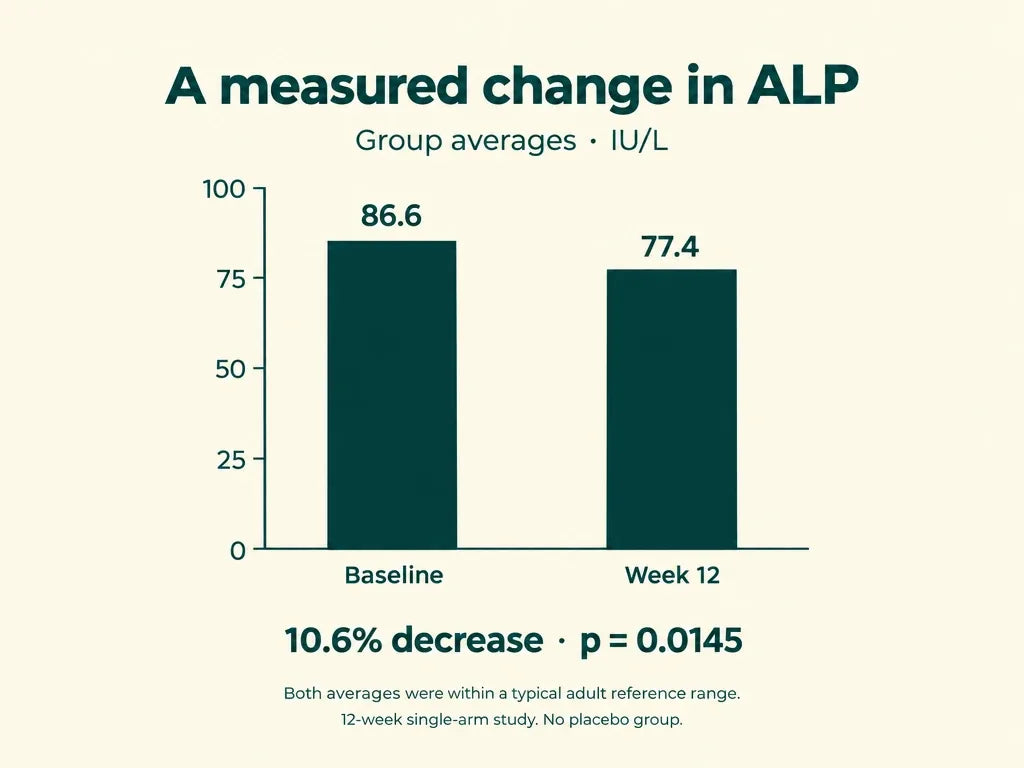
One marker in the bloodwork moved as well. Average alkaline phosphatase, or ALP, went from 86.6 to 77.4 IU/L across the 12 weeks, a 10.6% decrease.

Chart of average ALP measurements at baseline and week 12

Both averages sat inside a typical adult range. ALT, AST, albumin and bilirubin didn't change significantly.

The full summary is published on the Liverated site. And here's the part that matters. Forty adults took this exact formula, at the serving printed on this label, for twelve weeks. Their score was lower at every checkpoint.

Start the 12-week routine · $120

Three bottles, $120. Free USA shipping. Covered by the 90-day guarantee.

Robert H., a verified buyer, writing at the end of his first month.

Robert H., verified buyer
Two weeks in I noticed less bloating and some help sleeping. Before the end of the month I was convinced. Feeling better, more energy.
Robert H.Verified buyer

What no number shows is what a normal evening feels like.

What the evening can look like

The evening that doesn't end when dinner does.

A man standing to leave a restaurant with his wife, the evening still ahead
DinnerYou order what you want.The evening keeps going after the plates do.
A man at a garage workbench in the evening
The projectThe garage light is still on at eight.Dinner did not take the evening with it.

You're three cuts into a project you meant to finish in spring.

A man with friends on a patio in the evening
The plansYou say yes on Tuesday.You still mean it on Friday.

A friend texts Tuesday about Friday. You say yes. And you don't run the private math first about what to eat and how fast you can get home.

You walk to the car still talking.

michael b., a verified buyer, in his own words.

michael b., verified buyer
I have started doing more projects after work instead of just getting home and falling asleep watching T.V.
michael b.Verified buyer

None of those evenings are extraordinary. They are evenings you stopped counting on.

There's no honest way to promise them to you. But there's a fair way to test it.

Why three bottles

Give it the same window the study used.

The group's score didn't stop falling after the first month. It kept falling past week 4, through week 8, to 38.6% lower at week 12.

That's why the three-bottle supply exists.

One bottle is 30 daily servings. That carries you to the first checkpoint and stops.

Three bottles are 90 daily servings, the same 12-week window the study ran.

None of that says you need 90 days to feel anything. You get three check-ins instead of one.

One and two bottles run $49 a bottle.

Better: three bottles run $40 a bottle: $120 instead of the regular $147, with free USA shipping.

Save $27. About $1.33 a day!

With your permission, I'd like to send you all three. One decision, then ninety mornings to judge it.

The response form

Three bottles. Ninety mornings. One payment.

YES, send my 3-bottle study supply.

One-time purchase. No recurring deliveries. Ninety daily servings.

Three AlphaCleanse bottles with botanicals
Three bottles. 90 daily servings.
Enough for weeks 4, 8 and 12.
Regular $147$120one-time
  • 90-day guarantee, even if the bottles come back empty
  • Three bottles · 90 daily servings
  • $40 per bottle instead of $49
  • Save $27 off the regular $147
  • About $1.33 a day
  • Free USA shipping

Get my 3-bottle study supply · $120

Visa, Mastercard, American Express, PayPal and Discover accepted

Secure checkout on Liverated. Taxes and any location charges are confirmed at checkout.

And there's no obligation to keep it. But first, let me show you exactly what happens if it isn't right for you.

A full 90 days from delivery

What happens if it isn't right for you?

90 day money back guarantee seal
90 days from the day it arrives.
Return the bottles even if they are empty.

The box arrives. You take two capsules with your first meal, once a day. And you judge it at four weeks, then eight, then twelve.

Contact support within 90 days of delivery. Support emails you a prepaid return label. Send the bottles back, even if they are empty. Your refund follows after the return is received.

Of course, you're under no obligation to keep it. The decision is entirely yours.

There's one more thing people brace for. AlphaCleanse is taken with food, once a day. It isn't built as a purge.

Kellie S., a verified buyer, in her own words.

I feel less bloated and it's not like other cleanses I've tried no cramps or running to the bathroom and praying I make it.
Kellie S.Verified buyer

Here's the only pressure worth naming.

The next meal is coming either way.

Another month of changing three things at once teaches you nothing. A routine needs a starting date.

Order the 3-bottle supply

Straight answers before you decide

The questions that are left.

Could this fit the kind of bloating I deal with?

If ordinary meals keep leaving you full, heavy and bloated, and single-purpose fixes never settled the pattern, this may fit. AlphaCleanse is daily digestive support. Bloating has many causes, and the feeling alone can't tell you which is yours.

How do I take it, and when will I notice anything?

Two capsules once daily with your first meal. That's the routine the study used. The group was checked at weeks 4, 8 and 12, and the score was already lower at week 4. Your own experience can differ.

Why three bottles?

Three bottles are 90 daily servings, the full 12-week study window, at $120 instead of the regular $147. Every option on this page is a one-time purchase. Nothing recurs.

Is it a laxative? Will I get urgency or cramping?

It's taken with food, once a day, and it isn't built as a purge. The rhubarb root in it is 27.5 mg, the smallest of the three anchors. The study reported bowel regularity. It didn't establish your own stool response.

Was the Triple Relay itself tested?

No. The Triple Relay is our way of organizing three known digestive jobs. The study measured digestive symptoms and laboratory markers. It didn't measure gastric emptying, bile delivery or intestinal transit.

Does Digestive Drag mean my liver causes my bloating?

No. Digestive Drag is our plain-English name for lingering fullness, pressure and bloat. The liver and gallbladder do contribute bile to digestion. But a feeling of bloating can't identify a liver or gallbladder problem.

Can I take it with medication or a condition?

Have your clinician or pharmacist read the ingredient list first. That matters most if you take medication, are pregnant or nursing, or have a liver, gallbladder or digestive condition. Symptoms that persist or worsen deserve medical evaluation.

What if it isn't right for me?

Contact support within 90 days of delivery. Support emails you a prepaid return label. Send the bottles back, even if they are empty. Your refund follows after the return is received. The 90 days run from the day your order arrives.

Prefer a smaller start?

One or two bottles, if you'd rather begin small.

Both work out to $49 a bottle, with shipping calculated at checkout. And the 90-day guarantee runs from delivery either way, so a smaller start buys you no extra protection.

1 bottle of AlphaCleanse

1 bottle

30-day supply

$49

$49 per bottle

Buy once · $49
2 bottles of AlphaCleanse

2 bottles

60-day supply

$98

$49 per bottle

Buy once · $98

The decision

Same restaurant. Same dinner. A different night.

Same booth, a few months from now. The same order, the same wine. The talk is about the weekend, and your stomach never comes up.

I could keep going. What I'd rather do is let you judge it yourself. Three reasons this deserves a fair trial.

First, the Triple Relay explains the pattern: one meal, three handoffs.

Second, the finished formula was followed for 12 weeks, at the serving printed on the label.

Third, the guarantee puts the verdict in your hands for 90 days from delivery.

You already know how the old version of that night ends. So order the three-bottle supply, and take the first two capsules with breakfast the day the box lands.

Three AlphaCleanse bottles with botanicals
Three bottles. Ninety mornings. One payment.

Get my 3-bottle study supply · $120